Recently, the Ministry of Education of China officially approved the establishment of the Sino-Kazakh College of Information Engineering at Qingdao University of Science and Technology (QUST), jointly founded by QUST and Kazakh National Technical University. Following the Sino-German College of Technology, the new college marks the second Chinese-foreign cooperative educational institution of a non-independent legal status approved for the university. To date, QUST has established two Chinese-foreign cooperative educational institutions and six cooperative education programs, forming a multi-level international education framework covering disciplines such as science, engineering, and arts.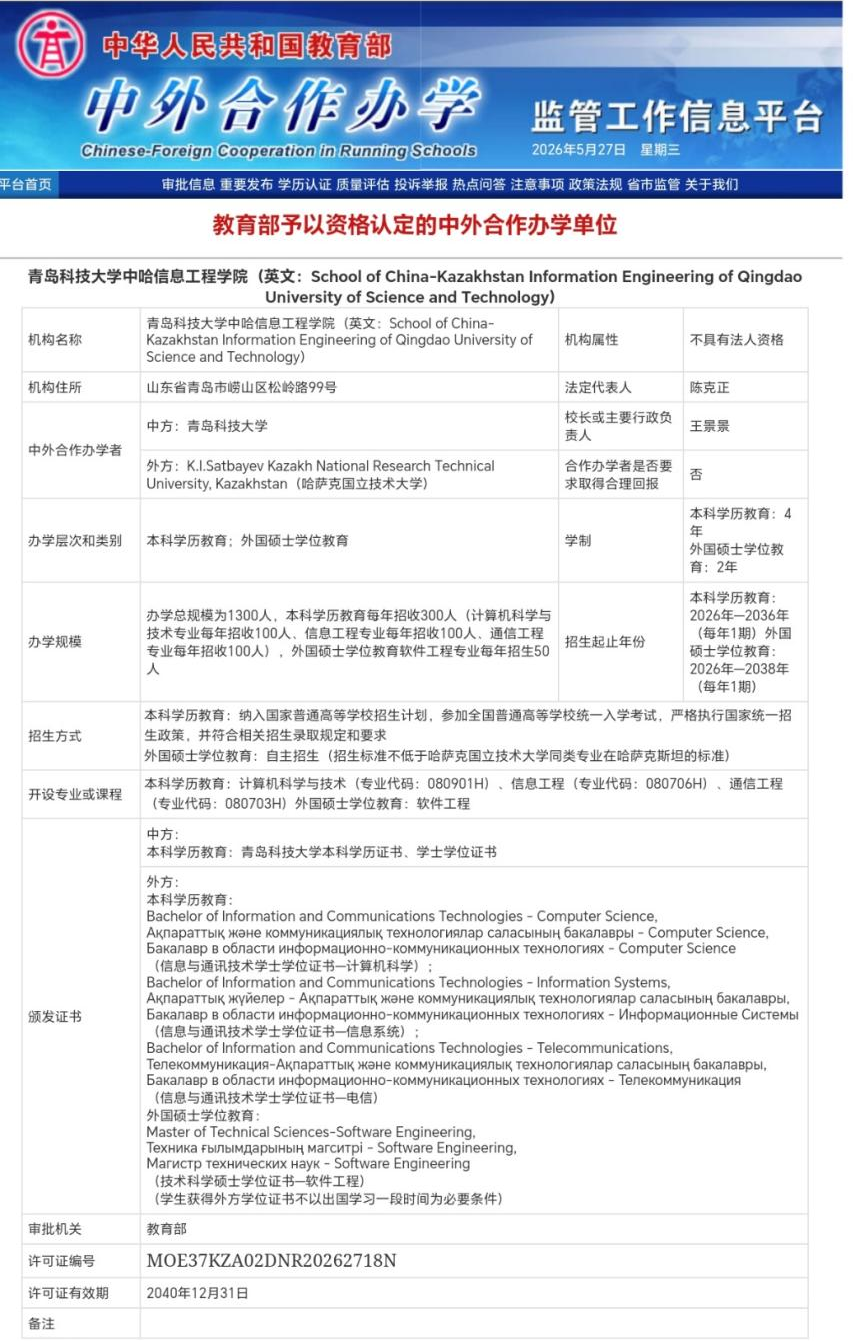
Founded in 1934, Kazakh National Technical University (KNTU) is one of Kazakhstan’s leading public research-oriented technical universities. Ranked 331st in the QS World University Rankings, the university enjoys a strong academic reputation and comprehensive strength. It has developed distinctive advantages in engineering education, particularly in computer science, information systems, communication technologies, software engineering, chemical engineering, and petroleum engineering, and exerts significant academic and industrial influence across Kazakhstan and Central Asia. With its advanced educational philosophy, high-quality teaching resources, and strong research capabilities, the university will provide comprehensive support for the new institution through an internationalized curriculum, distinguished faculty, and cutting-edge research opportunities.
Positioned in Shandong Province while serving both China and Kazakhstan and extending its influence across Central Asia, the Sino-Kazakh College of Information Engineering will focus on key information technology disciplines and establish a comprehensive talent cultivation system. The college will offer three undergraduate programs and one foreign master’s degree program, with all courses taught by Kazakh faculty delivered in English.
The undergraduate programs include Computer Science and Technology (corresponding to KNTU’s Computer Science program), Information Engineering (corresponding to KNTU’s Information Systems), and Communication Engineering (corresponding to KNTU’s Communications). These programs are included in China’s national undergraduate enrollment plan and follow a four-year study period under a “4+0” dual-degree model. Students will complete their entire course of study at QUST. Upon fulfilling the academic requirements and graduation standards of both institutions, graduates will receive a bachelor’s degree certificate and graduation certificate from QUST, as well as a bachelor’s degree from Kazakh National Technical University.
The master’s program, Software Engineering (corresponding to KNTU’s Software Engineering program), will adopt an independent admissions system and a two-year “2+0” single-degree training model. Students will complete all coursework at QUST and, upon meeting the graduation requirements, will be awarded a master’s degree from Kazakh National Technical University.
The Sino-Kazakh College of Information Engineering is scheduled to begin student enrollment in 2026.