To thoroughly study and implement the spirit of the Fourth Plenary Session of the 20th Central Committee of the Communist Party of China, support Chinese-style modernization through scientific and technological modernization, actively respond to the strategic call of “developing new quality productive forces”, and promote the interdisciplinary integration of “Intelligence + Chemical Engineering” and industrial innovation and upgrading, Qingdao University of Science and Technology (QUST) officially inaugurated the Intelligent Chemical Engineering Research Institute on November 3. The inauguration ceremony was held at the Mesnac Lecture Hall of the Laoshan Campus.
Distinguished guests attending the ceremony included renowned Chinese and foreign scholars such as Academician Chai Tianyou of the Chinese Academy of Engineering and Professor of Northeastern University, Academician Song Yongduan of the International Eurasian Academy of Sciences, Editor-in-Chief of the international authoritative journal TNNLS, and Professor of Chongqing University, Professor Ivan Tyukin of King’s College London and Member of the UK Engineering and Physical Sciences Research Council; government officials including Shi Zhiyuan, Director of the Department of Science and Technology of Shandong Provincial Department of Education, and Yu Bingbo, Deputy Director of Qingdao Municipal Bureau of Science and Technology; responsible persons from leading industry enterprises such as Sinopec and Sailun Group; as well as QUST leaders including Yang Tianmei, Secretary of the Party Committee, Chen Kezheng, President, Luo Xiliang, Member of the Party Committee Standing Committee and Vice President, Li Jinhong, Vice President, and Wang Dianhui, National-level Talent and Second-Class Professor

On behalf of QUST, Yang Tianmei extended a warm welcome and sincere gratitude to the experts, leaders, and entrepreneurs present. He noted that the global energy and chemical industry is actively transitioning towards greenization, low-carbonization, and intelligence, and the upgrading of the chemical industry is crucial to the security and resilience of the national industrial chain and supply chain. As a key driver leading the new round of technological revolution, artificial intelligence is profoundly empowering many critical links such as the optimization of chemical processes, the upgrading of intelligent control systems, and full-chain safety management, providing important technical support and path breakthroughs for achieving self-reliance and self-improvement in scientific and technological innovation in the chemical industry. Promoting the in-depth integration of the chemical industry with AI is not only an inevitable requirement for industrial transformation but also a strategic measure to enhance national independent innovation capabilities and consolidate the foundation of industrial security.
He emphasized that QUST will give full play to its disciplinary accumulation in chemical engineering, materials science, software, and AI, integrate high-quality innovative resources, and adhere to the principles of high-starting-point layout, in-depth interdisciplinary integration, open cooperation, and distinctive development. The university strives to build the institute into a top domestic and internationally renowned interdisciplinary innovation hub for “AI + Chemical Engineering” and a key base for high-level talent training, helping to solve the “bottleneck” problems in key processes of the chemical industry and empower the digital transformation of the industry

Chen Kezheng presented appointment letters to external members of the Institute’s Expert Advisory Committee, including Academician Song Yongduan, aiming to gather high-level think tank support for the institute's development and assist QUST in achieving more breakthrough results in interdisciplinary fields such as “AI + Chemical Engineering”. It is understood that Wang Dianhui will serve as the first Dean of QUST's Intelligent Chemical Engineering Research Institute
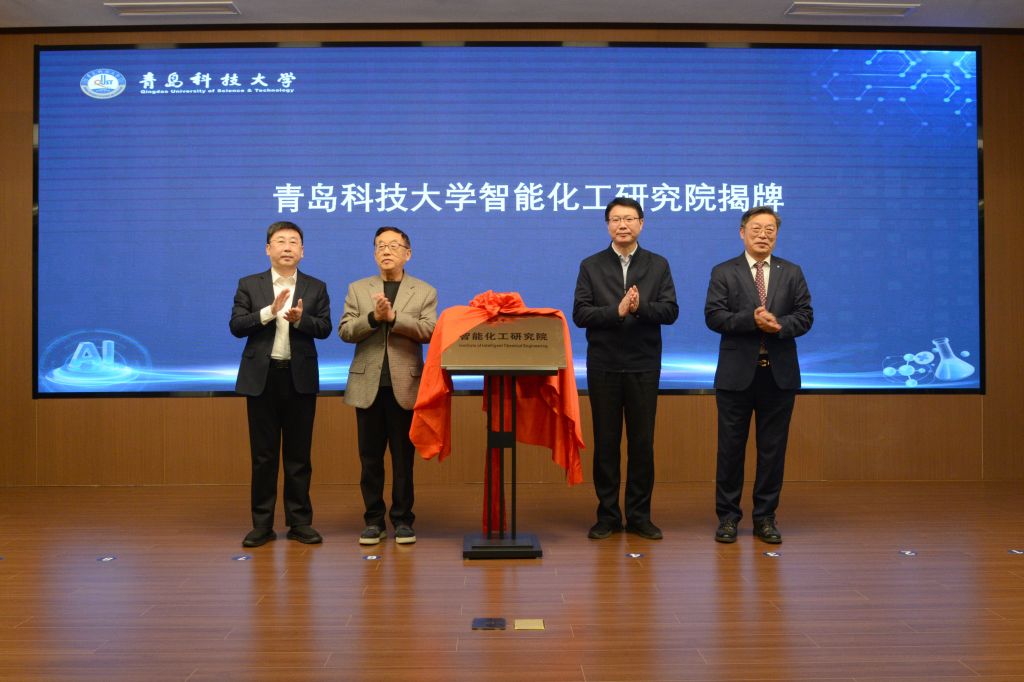
At the ceremony, Chai Tianyou, Shi Zhiyuan, Yu Bingbo, and Wang Dianhui jointly unveiled the plaque for the institute. Wang Le, Manager of the Public Technology Office of Sinopec's Science and Technology Department, delivered a speech on behalf of participating enterprises.

Following the inauguration, a Frontier Forum on Interdisciplinary Disciplines was held. Academician Chai Tianyou, Academician Song Yongduan, and other experts delivered academic reports on themes such as the training of intelligent science and technology talents, high-level academic research, AI-enabled green chemistry, and the application of AI technology. During the event, a seminar on the development plan of the Intelligent Chemical Engineering Research Institute was also organized.

More than 200 participants attended the event, including representatives from enterprises in the chemical engineering and AI fields, responsible persons from relevant departments and colleges of QUST, core members of the institute, and representatives of teachers and students.
It is reported that QUST's Intelligent Chemical Engineering Research Institute adheres to the orientation of serving national major strategic needs, takes promoting the high-end, intelligent, and green development of the chemical and rubber industries as its mission, and anchors the strategic positioning of “serving national strategies, supporting regional development, and leading industrial progress”. Guided by the main development line of QUST during the 15th Five-Year Plan period, the institute will forge a high-quality development path with distinctive QUST characteristics.
Relying on the university’s accumulation in fields such as chemical engineering and technology, the institute will further promote the in-depth integration of AI with QUST’s traditional disciplines including chemical engineering and rubber, providing key technologies, high-end talents, and intellectual support for the digital transformation and safe development of China's chemical industry. Positioned as a top domestic and internationally renowned interdisciplinary innovation hub, talent training base, and achievement transformation hub for AI + Chemical Engineering, the institute upholds the concept of Openness, Collaboration, Innovation, and Excellence and aims to build an overall development pattern of Four Zones, Three Bases, and One Platform.
With advanced AI algorithms suitable for chemical data modeling and predictive analysis as the core technology, the institute will systematically and in-depth study the mechanism analysis and prediction problems arising in chemical processes, conduct basic and applied research, and extend to predictive analysis and intelligent control issues in related fields such as rubber and new energy. It will focus on four key research directions:
Research on lightweight stochastic configuration learning theory for industrial control and prediction;
AI-enabled predictive control and digital twin technology for complex industrial processes;
AI-enabled low-carbon operation optimization of chemical/rubber production processes;
AI-enabled chemical safety early warning and emergency response.
Taking technological innovation as its mission and serving national major strategic needs as its orientation, the institute will remain committed to deepening interdisciplinary integration, accelerating achievement transformation, and contributing QUST’s wisdom and strength to the digital transformation and intelligent upgrading of China's chemical industry.
Profile of Wang Dianhu

Wang Dianhui is a Second-Class Professor, Doctoral Supervisor, National-level Talent, Dean of the Intelligent Chemical Engineering Research Institute, and Academic Leader of the AI for Engineering discipline. His main research fields include lightweight stochastic configuration learning theory for industrial AI, stochastic configuration learning theory and application of knowledge information, and complex industrial big data modeling theory and application.
In 2017, he founded the Stochastic Configuration Networks (SCN) learning theory, which fundamentally solved the core problems long existing in stochastic learning technologies, broke through the restriction on the differentiability of activation functions in the error backpropagation algorithm traditionally used for training neural networks, and adopted a supervised learning mechanism to address the long-standing bottleneck of determining model structures in neural network modeling. In 2023, based on deep SCN, he proposed the lightweight and interpretable Stochastic Configuration Machines (SCM) theory, and for the first time put forward the concept of learning model complexity, proving that the model complexity not lower than the data complexity is a necessary condition for the first-order global approximation property of learning models.
In 2022, he founded the international academic journalIndustrial Artificial Intelligenceand serves as its Editor-in-Chief. He currently holds the position of Associate Editor for academic journals such asIEEE Transactions on Fuzzy Systems,Information Sciences, andWIREs Data Mining and Knowledge Discovery, and previously served as Associate Editor for international academic journals includingIEEE Transactions on Neural Networksand Learning Systems,IEEE Transactions on Cybernetics, andArtificial Intelligence Review.